
 简体中文
简体中文Search for More Information


Does the lead of the ball screw affect the accuracy of the linear module? Under the same conditions, if the lead of the ball screw is 5 or 10, what impact does it have on the repeatability accuracy. Now let RYK Jiayi Intelligent analyze the precision factors that affect our module here.
Ball screws are divided into grinding grade and ordinary rolling grade, with grinding grade being C3C5C7, etc. The positioning of ball screw lead accuracy is based on the modified 1987 JIS standard: 1. Cumulative measurement of motion error; 2. Deviation amplitude within the effective travel range; 3. Any equal distance deviation amplitude of 30cm; 4. The deviation amplitude of any lead rotating once. Lead calculation formula=screw distance * number of threads; A motion with a relatively large lead has a longer distance traveled in one week.
Servo motor control PLC pulse control, originally 2000 pulses per lead 5, now 2000 pulses per lead 10, relative accuracy has increased, there may be some impact, and the distance per unit pulse has changed.
The accuracy error of the linear module is also affected by the runout error of the concentricity of the ball screw mounting seat, bearings, and connectors during operation, which affects the simplicity of positioning.
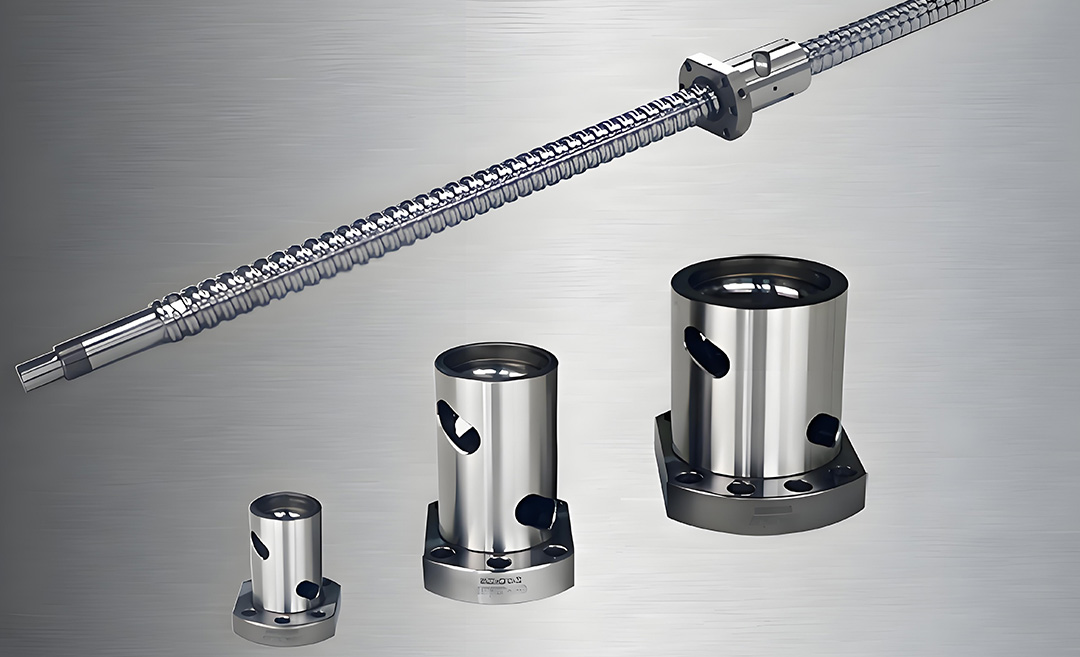
The types of lead of ball screw include metric, imperial, and modular (such as pai screw, such as 3.14, 6.28, etc.). Lead has a significant impact on the transmission accuracy of screw, with adjacent helix errors and cumulative helix errors. Please refer to the mechanical design manual for details. Ball screw is a commonly used transmission component in tool machinery and precision machinery. Its main function is to convert rotational motion into linear motion or torque into axial repetitive force, while also possessing the characteristics of high precision, reversibility, and high efficiency. Due to its low frictional resistance, ball screws are widely used in various industrial equipment and precision instruments.